


Inspiron Air iAIRHP-35-CC/CC-ERV
is illegal and non-compliant
Innova’s Million Dollar Challenge
Failure to be listed in the NRCan Searchable Product List
In Canada, all air-conditioning and heat-pump systems must be listed in the NRCan database. In fact, it is illegal to import or sell a unit that is not listed. At the time of this publication, March 16, 2026, neither the Inspiron Air iAIRHP-35-CC nor the Inspiron Air -iAIRHP-35-CC-ERV can be located in the NRCan Searchable Product List.
As an amusing side note, although not AHRI-listed at all, Inspiron Air places an AHRI text box at the top of each page of its brochure. Do they think that will actually fool people into thinking they are AHRI certified?!

Failure to meet NRCan Minimum Efficiency Requirements
The Inspiron Air iAIRHP-35-CC and Inspiron Air -iAIRHP-35-CC-ERV have a claimed nominal cooling capacity of 12,000 BTU.
Under federal law, any 12,000 BTU heat pump in this class must meet:
13.4 SEER2 minimum to be legally sold, installed, or used in Canada.
Inspiron Air misrepresents itself by publishing a 16.95 SEER rating, making it appear to comply; however, that rating is impossible and fake.
This alone renders the units illegal.
Fraudulent and Fake Numbers
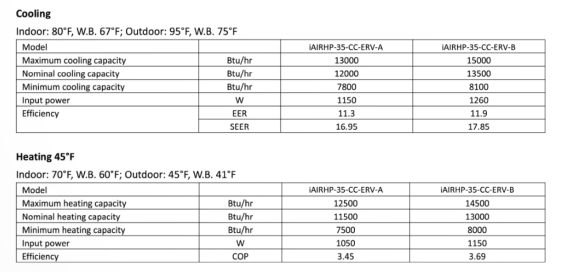
Inspiron Air misrepresents even the fake numbers it publishes for iAIRHP-35-CC and -iAIRHP-35-CC-ERV in both heating and cooling, as the math doesn’t add up.
In Cooling
- Cooling Capacity: 12,000 BTU
- Power Input: 1,150 W
-
Using Inspiron Air’s own watt input:
12,000 ÷ 1,50 = EER 10.43
Yet the Inspiron Air has an EER of 11.3. In heating, Inspiron Air still can’t do simple math.
In Heating
- Heating Capacity: 11,500 BTU
- Power Input: 1,050 W
-
Using their own watt input:
11,500 ÷ 3.412 (BTU to W) ÷ 1,050 = 3.21 COP
Yet Inspiron Air reports a 3.45 COP.
Inspiron Air is playing with the numbers. The numbers they published looked too good to be true, so they simply “dumbed down” the efficiency.
When tested in a lab, the Inspiron Air iAIRHP-35-CC and -iAIRHP-35-CC-ERV will not produce 12,000 BTU at a 16.95 SEER rating, as claimed. The actual numbers they claim are fake.
It also seems that Inspiron Air simply copied and pasted these numbers, along with the same mathematical errors, from another unit they copied from us, the iAIRHP-35-WM-A.
Summary of Violations
Inspiron Air iAIRHP-35-CC and -iAIRHP-35-CC-ERV:
- Failure to list on the NRCan database
- Publishes fabricated numbers in cooling
- Publishes fabricated numbers in heating
- Uses illegal rating metrics, COP instead of HSPF2
- Uses illegal rating metrics SEER instead of SEER2
- Violates NRCan product classification rules
- Violates NRCan labeling requirements
- Fails SEER2 minimums because efficiency numbers are falsified
- Fails HSPF2 minimums because numbers are fake
- Contradict basic mathematics in efficiency numbers
- Fails to use the correct testing methods
- Violate the Competition Act (R.S.C., 1985, c. C-34), which prohibits deceptive efficiency claims
Inspiron iAIRHP-35-CC and -iAIRHP-35-CC-ERV cannot legally be sold, installed, or used in Canada, and we back that statement with a $1,000,000 Guarantee.
Illegal to Distribute, Install, and Use
Inspiron Air iAIRHP-35-CC and iAIRHP-35-CC-ERV are illegal to distribute, specify, install, or use because they are not listed in the NRCan database and do not meet NRCan’s heat pump energy-efficiency requirements. To meet the NRCan requirement, this unit would need to have an SEER2 rating of at least 13.4 at 12,000 BTU and an HSPF2 rating of at least 5.4 at 11,500 BTU. This rating cannot simply be invented; it must be established through testing in a genuine lab.
How Everyone Gets Hurt

Sellers
Private labelers, Manufacturers,
Distributors, Dealers, Resellers
Selling a non-compliant HVAC product is a direct violation of the Energy Efficiency Act and NRCan regulations. Sellers are exposed to:
Federal Civil Penalties
NRCan may prosecute for non-compliance for every unit distributed in commerce. Penalties stack and can reach six-figure outcomes per model.
Product Seizure and Forced Recall
NRCan can seize inventory, block further distribution, and mandate recall or destruction of illegal equipment.
Competition Bureau enforcement… Competition Act Section 52
Publishing fabricated ratings constitutes a deceptive trade practice under the Competition Act. This exposes the seller to federal enforcement, mandatory corrective advertising, and civil penalties.
Breach of Contract and Indemnification Claims
Developers, contractors, and property owners can sue the seller for damages if the installed equipment fails inspection, fails commissioning, or causes code violations.
Class-Action Exposure
Tenants, condominium associations, and homeowners’ groups can sue for misrepresentation, damages, inflation in energy costs, or unsafe equipment.
Loss of Manufacturer and Distributor Licenses
OEM partnerships and distribution channels can be terminated for selling illegal equipment.
Selling these units is both legally and financially dangerous.

Installers
Contractors, HVAC technicians, MEP firms
Installing non-compliant equipment exposes the installer to direct professional and legal risk.
Violation of state and local mechanical codes
Most jurisdictions require installed equipment to be listed, certified, and compliant with NRCan minimums. Installing unlisted units violates the code.
Loss of contractor license
Boards can suspend or revoke licenses for installing non-certified or illegally rated equipment.
Civil liability for damage
If the unit fails, performs below specifications, overdrafts electrical circuits, leaks refrigerant, or causes mold or structural damage, the installer can be sued.
Professional negligence claims
Installing non-certified equipment is a breach of standard practice.
Insurance denial
Work performed with illegal equipment can void contractor liability insurance coverage.
Installers who choose these units are assuming direct legal and financial responsibility.
Loss of Contractor License
Boards can suspend or revoke licenses for installing non-certified or illegally rated equipment.
Civil Liability for Damage
If the unit fails, performs below specifications, overdrafts electrical circuits, leaks refrigerant, or causes mold or structural damage, the installer can be sued.
Professional Negligence Claims
Installing non-certified equipment is a breach of standard practice.
Insurance Denial
Work performed with illegal equipment can void contractor liability insurance coverage.
Installers who choose these units are assuming direct legal and financial responsibility.

Engineers
MEP engineers, Specifiers, Consultants
Engineers face a high risk of exposure if they specify or approve the use of illegal equipment.
Professional malpractice exposure
Specifying equipment that does not meet SEER2 or CEER requirements, or does not appear in AHRI/NRCan Searchable Product Lists with accurate data, is a breach of engineering duty.
Loss of PE license
Stamping drawings with illegal or misclassified equipment creates a direct disciplinary risk.
Design liability
If the equipment fails to meet code, fails load calculations, causes tenant complaints, or drives excessive energy use, the engineer is liable for damages.
Insurance exposure
Errors & Omissions insurers reject claims involving knowingly illegal equipment.
Any engineer who signs off on these units is accepting personal liability.

Building Owners
Developers, Property managers, REITs, Condo associations
Owning a building with illegal HVAC equipment exposes the owner to substantial financial and legal risks.
Code violations and failed inspections
Buildings containing non-certified equipment can fail Local Authority inspections.
Forced removal and replacement
Authorities can mandate the removal of every installed unit, at the owner’s expense.
Insurance cancellation or claim denial
If the equipment is not legal or not NRCan-compliant, insurers may deny coverage or void property insurance policies.
Reduced property value
Buildings with illegal equipment face valuation reductions, impaired financing, and lender objections.
Tenant lawsuits and warranty claims
Tenants can sue for non-performance, high heating/cooling costs.
Fines and enforcement actions
Owners can be fined for every illegal unit installed or operated within the building.
Owning or operating these units exposes the property to material legal and financial damage.

End-Users
Residents, Tenants, Homeowners
Even the resident or end-user is exposed to risk when using non-compliant equipment.
High energy bills and poor performance
Because the published performance data is fake, real-world operating costs are substantially higher than the claimed ratings suggest.
End-users bear financial burdens due to equipment that consumes more power and has limits.
The Million Dollar Challenge
Innova guarantees that the performance numbers published by “Inspiron Air” are fake.
Innova will pay one million CAD to any manufacturer, distributor, engineer, or entity that can produce a certified, independent laboratory test report corroborating the claimed capacity and efficiency when tested in accordance with DOE regulations.