Published Specifications
Overview
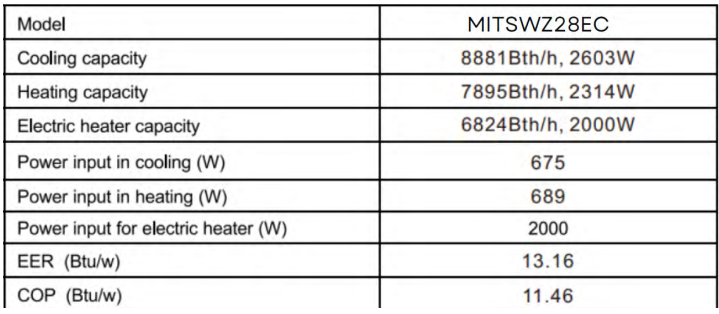
The Mits Air MITSWZ-28EC is a residential mini-split unit marketed in Canada with a claimed nominal cooling capacity of 8,881 BTU and a claimed heating capacity of 7,895 BTU. A review of its published specifications and regulatory standing reveals multiple serious compliance failures under Canadian federal law, as well as technical inconsistencies that undermine the credibility of the manufacturer’s published data.
Failure to be listed in the NRCan Searchable Product List
Under Canadian federal regulations, all air-conditioning and heat-pump systems must be listed in Natural Resources Canada’s (NRCan) Searchable Product List before they can be legally imported, distributed, or sold. As of the date of this publication, the MITSWZ-28EC does not appear in that database under any applicable product category — including Room Air Conditioner, Heat Pump, or Packaged Terminal Heat Pump (PTHP).
This absence alone constitutes a violation of federal law, independent of any other deficiency identified in this analysis.
Failure to meet NRCan Minimum Efficiency Requirements
Canadian federal regulations establish minimum efficiency thresholds for units in this capacity class. Depending on classification, the MITSWZ-28EC would be required to meet one of the following:
Mits Air publishes neither a SEER2 nor a CEER for cooling, and no HSPF2 for heating. Instead, the company publishes EER and COP values — metrics that do not satisfy Canadian regulatory requirements and cannot be used as substitutes for the mandated ratings. The absence of any compliant efficiency rating renders the unit illegal to sell, install, or use in Canada, regardless of its actual performance.
The Zymbo Connection
The MITSWZ-28EC is manufactured by Zymbo, which markets the identical unit as the WZ-28EC. The two products share the same compressor, coil geometry, refrigerant charge, airflow path, and chassis. The only distinguishing feature is the nameplate.
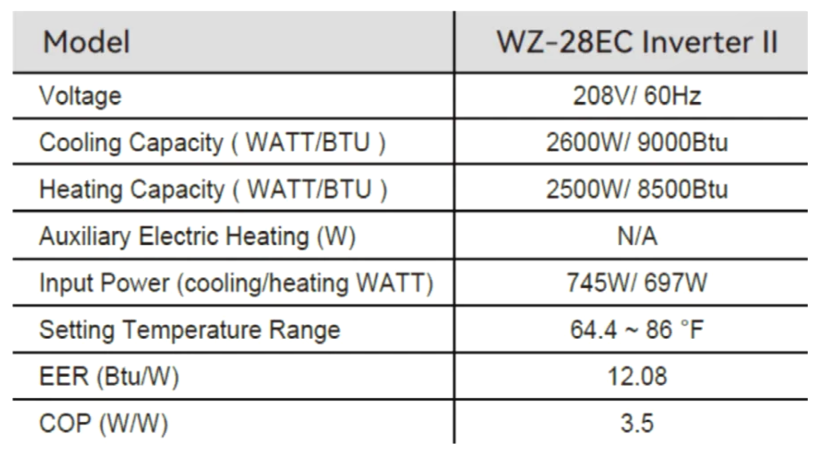
A direct comparison of the published specifications from both companies reveals figures that are physically inconsistent:
Let’s compare the data from the manufacturer, Zymbo to Mits Air:
Cooling: An Implausible Efficiency Gain
Mits Air’s figures show a 9.4% reduction in input power while cooling capacity falls by only 1.3% — producing an apparent 8.9% improvement in EER. On identical hardware with identical refrigerant, this is not physically achievable. A reduction in input power of that magnitude would require a corresponding reduction in capacity, not a trivial one.
Heating: An Implausible Efficiency Loss
The heating figures are even more inconsistent. Mits Air reports a 19.7% reduction in heating capacity compared to Zymbo, while input power is reduced by only 1.1%, and COP actually declines by 4.0%. Thermodynamically, a substantial reduction in output capacity on the same hardware, with nearly unchanged power consumption, is not possible. Furthermore, lower capacity at similar power input should generally produce higher efficiency, not lower. The direction and magnitude of these changes are irreconcilable with the laws of thermodynamics.
The only coherent explanation is that Mits Air’s published figures were not derived from laboratory testing. They appear to have been manually entered without a credible empirical basis.
Regulatory Classification and Labelling Violations
Because the MITSWZ-28EC carries no recognized efficiency rating — no CEER, no SEER2, no HSPF2 — it cannot satisfy the classification or labelling requirements under any applicable NRCan product category. To achieve legal status, the unit would require:
These ratings cannot be self-declared or calculated from published wattage figures. They must be derived from standardized test procedures conducted at an accredited facility.
Regulatory Violation Summary
Mits Air — MITSWZ-28EC
This product is illegal to distribute, specify, install, or use in Canada. The MITSWZ-28EC carries no compliant efficiency ratings, is absent from the NRCan product registry, and its published technical data contains internal contradictions that are physically impossible and inconsistent with any laboratory-derived measurements. The published EER and COP figures cannot be reconciled with the specifications of the identical Zymbo WZ-28EC — the unit’s own manufacturer — nor with basic thermodynamic principles.
One Million Dollar Guarantee
We back the statement that the Mits Air — MITSWZ-28EC cannot legally be sold, installed, or used in the United States and Canada with a One Million Dollar Guarantee.
No Compliant Efficiency Data Published
The absence of compliant efficiency ratings is not an oversight. Published EER and COP figures that contradict those of the unit’s own manufacturer and that are inconsistent with physical reality are not measurements — they are fabrications. Under the Competition Act, both false statements and material omissions of required performance data are equally actionable.
Faking Test Results
Selling Products That Should Not Be on the Market
Lying to Customers and Regulators
Breaking Consumer Protection and Competition Laws
Mits Air MITSWZ-28EC cannot legally be sold, installed, or used in Canada, and we back that statement with a One Million Dollar Guarantee.