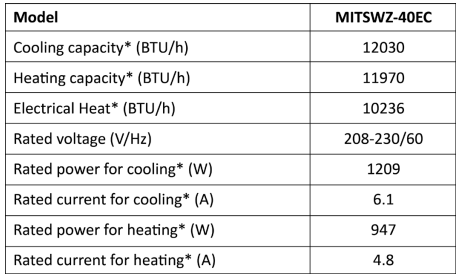
Published Specifications
Failure to be Listed in the NRCan Searchable Product List
In Canada, all air-conditioning and heat-pump systems must be listed in the NRCan database. It is illegal to import or sell a unit that is not listed. At the time of this publication, March 16, 2026, the Mits Air MITSWZ-40EC cannot be located in the NRCan Searchable Product List under any product category — not as a Room Air Conditioner, not as a Heat Pump, and not even as a PTHP.
Failure to Meet NRCan Minimum Efficiency Requirements
Mits Air MITSWZ-40EC has a claimed nominal cooling capacity of 12,030 BTU and a claimed heating capacity of 11,970 BTU. Under federal law, any unit in this class must meet one of the following minimum efficiency thresholds to be legally sold, installed, or used in Canada:
Mits Air publishes neither a SEER2, nor a CEER, nor an HSPF2. Unlike most brands in this report that at least attempt to publish some form of efficiency data — however fraudulent or mislabeled — Mits Air publishes only cooling capacity in BTU and power input in watts. No SEER2. No CEER. No HSPF2. No EER. No COP. Nothing.
This is not a shortcut or a simplification. It is a complete failure to comply with federal law, and it raises an obvious question: if the unit’s efficiency were genuinely competitive, why would Mits Air choose not to publish it?
This alone renders the unit illegal, regardless of any other violation.
What the Published Data Actually Shows
Although Mits Air declines to publish an efficiency rating, its own capacity and wattage figures allow the efficiency to be calculated directly.
Using Mits Air’s own published figures: 12,030 ÷ 1,209 = EER 9.95. CEER is always lower than EER, so while the requirement is 9.3 CEER, it’s possible this unit can achieve 9.3 CEER based on the numbers they publish. However, that is a big if, because it assumes the unit can actually achieve 12,030 with only 1,209 watts of power, which is impossible.
Using Mits Air’s own published figures: 11,970 ÷ 3.412 ÷ 947 = COP 3.70. COP is not a legal rating for this product category. The required metric is HSPF2. Units achieving a COP of approximately 3.70 at rated conditions typically meet the required 5.4 HSPF2 minimum when properly tested under AHRI 210/240 conditions across multiple climate zones.
The Zymbo Connection
Zymbo manufactures the Mits Air MITSWZ-40EC, the same model on which the Zymbo WZ-40EC is based. The hardware is identical: same compressor, same coil geometry, same refrigerant charge, same airflow path, same chassis. The only difference is the name on the front panel.
Zymbo’s published specifications for this platform have been independently verified as fabricated, as detailed in the Zymbo WZ-40EC section of this report. Mits Air chose not to reproduce Zymbo’s fake EER and COP values, instead leaving the efficiency fields blank. This may reflect an awareness that Zymbo’s numbers are mathematically indefensible. But omitting the ratings entirely is itself a federal violation — and it does nothing to change the fact that the underlying hardware cannot meet Canadian efficiency standards, regardless of brand name.
Illegal Misclassification
The MITSWZ-40EC does not meet any classification because it has no rating. This is illegal.
Regulatory Violation Summary
Mits Air — MITSWZ-40EC
This product is illegal to distribute, specify, install, or use in Canada. The MITSWZ-40EC publishes no efficiency rating of any kind — no SEER2, no CEER, no HSPF2, no EER, and no COP. A product that refuses to publish any efficiency data cannot be evaluated, certified, or legally sold. Furthermore, the MITSWZ-40EC uses identical hardware to the Zymbo Dolphin 40, a product whose published specifications have been independently proven to be fabricated.
One Million Dollar Guarantee
We back the statement that the Mits Air — MITSWZ-40EC cannot legally be sold, installed, or used in the United States and Canada with a One Million Dollar Guarantee.
No Efficiency Data Published
The complete absence of any efficiency data is not an oversight. It is a material omission that prevents regulators, dealers, specifiers, and consumers from evaluating whether this product meets any applicable standard. Under the Competition Act, a material omission is treated the same as a false statement.
Faking Test Results
Selling Products That Should Not Be on the Market
Lying to Customers and Regulators
Breaking Consumer Protection and Competition Laws